
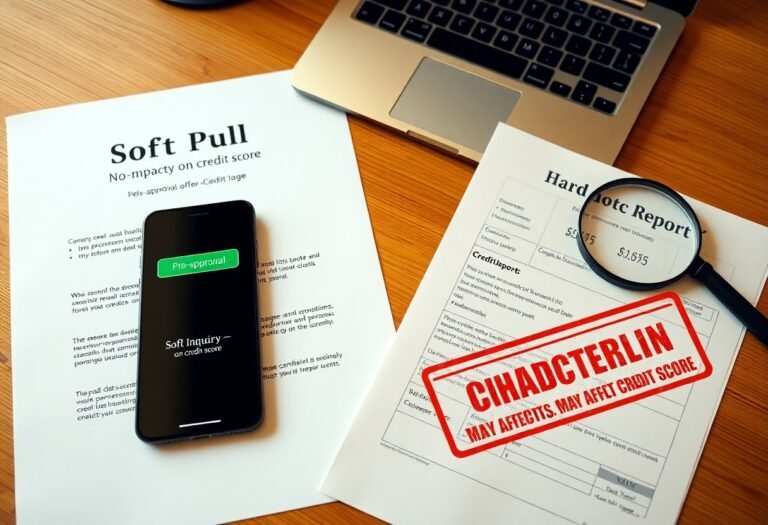
Consent determines whether a soft pull or hard pull appears on your credit report, how lenders view the inquiry, and whether your score may change, so you can decide when to authorize checks.
Key Takeaways:
- Soft pull: informational credit check that does not affect your credit score and typically appears only on your personal credit report.
- Hard pull: credit inquiry used for lending decisions that can lower your score slightly and remains visible on credit reports for two years.
- Lenders use soft pulls for prequalification, account reviews, and background checks; hard pulls occur when you apply for new credit and give authorization.
- Multiple hard inquiries for the same loan type within a short window are often treated as a single inquiry by scoring models (common windows: 14-45 days).
- Ask whether a lender will perform a soft or hard pull before applying and use prequalification or soft-check offers to avoid unnecessary score impacts.
Defining the Credit Inquiry
While a credit inquiry records when a lender or company checks your file, you should know soft pulls don’t affect scores and hard pulls can lower them temporarily.
The role of credit reporting agencies
Along with data from creditors, credit reporting agencies compile your payment history, balances, and public records so you can review and dispute inaccuracies.
Why lenders require access to your history
To evaluate your risk, lenders pull your credit to set rates, decide approvals, and determine credit limits, so you should apply strategically.
It gives lenders insight into payment patterns, account age, and utilization, which affects the terms you’re offered; you can improve outcomes by reducing balances and fixing errors before applying.
The Mechanics of a Soft Credit Pull
Some soft pulls happen when a company checks your file without seeking to open credit; they view limited info and you aren’t applying for new credit. You can see these inquiries on your report, but they stay visible only to you and don’t create a new account.
Common triggers: Pre-approvals and background checks
Credit pre-approvals, periodic account reviews, and identity checks often trigger soft pulls; these let companies estimate risk without opening accounts. You may consent to some checks, and soft pulls won’t block future credit applications.
Why soft inquiries do not affect your credit score
On credit scores, soft inquiries don’t affect your numeric score because scoring models ignore them; only hard inquiries from credit applications are counted. You can have many soft pulls without score impact, though lenders may note frequency when assessing offers.
A soft inquiry accesses only a snapshot of your file for informational or screening purposes, so scoring algorithms exclude it; hard inquiries follow your explicit application and signal potential new debt, which can lower your score. You can monitor soft pulls on your reports and dispute any inaccuracies with the bureaus.
The Implications of a Hard Credit Pull
Now a hard credit pull lets lenders access your full report, so you may appear a slightly higher risk; that can lower approval odds or raise interest rates for several months.
Standard scenarios: Loan and credit card applications
At loan or credit card applications you authorize a hard pull, and lenders use the results to set approvals, limits, and interest; applying selectively helps you avoid unnecessary score impacts.
Understanding the temporary impact on your score
your score can dip a few points after a hard inquiry, usually recovering within months if you keep balances low and avoid new credit requests.
Another detail: multiple inquiries for the same type of loan within a short window typically count as one inquiry, so you can rate-shop without multiplying damage; still limit unrelated applications.
Legal Consent and Authorization
All credit inquiries require your permission; a soft pull usually occurs without explicit consent for informational checks, while a hard pull requires your written or electronic authorization. See Hard vs soft credit check: What’s the difference? to learn how consent affects you.
Differences in how you agree to each pull type
Behind most applications, you click or sign to authorize a hard pull; soft pulls often happen when you check your own score or a company screens you without formal consent, so you should check terms before sharing info.
Your rights under the Fair Credit Reporting Act
Legal protections let you dispute errors, see who accessed your report, and limit sharing; you can request copies and correct inaccuracies to protect your credit standing under the FCRA.
agree you can file disputes with credit bureaus, place or lift a security freeze, obtain free annual reports, and the bureaus generally must investigate within 30 days when you provide documentation.
Strategic Management of Inquiries
Your inquiry strategy affects credit scores and approvals; time applications, use prequalification for soft pulls, and restrict hard pulls to necessary applications to protect your rating.
Utilizing the “rate shopping” window for major loans
Inquiries from multiple lenders within a short span count as one for scoring; concentrate rate shopping into that window to compare mortgages or auto loans without harming your score.
Minimizing the frequency of hard inquiries
Along with tracking your credit, plan applications and avoid unnecessary hard pulls; limit new accounts and space out credit requests to keep inquiries from lowering your score.
To reduce hard inquiries, use soft-prequalification tools, compare lenders within the rate-shopping window, request preapproval rather than full applications, avoid unnecessary credit requests, and monitor your credit reports to dispute unauthorized checks promptly.
Monitoring and Correcting Your Report
Keep checking your credit reports from the three bureaus regularly, dispute errors promptly, and track changes to inquiries. You can use free annual reports, monitoring services, or alerts to spot unauthorized hard pulls and protect your score.
Identifying unauthorized hard pulls
Before assuming a lender pulled your report maliciously, check account activity, recent applications, and authorized checks. Compare report dates to application records, contact listed creditors for clarification, and flag unfamiliar inquiries with the bureau to begin investigation.
The process for disputing inaccurate inquiries
Beside filing an online dispute with the credit bureau, include a copy of your ID, a statement explaining the error, and any supporting documents. Send disputes to the creditor as well, keep records, and follow up until the bureau resolves the inquiry or corrects the report.
pulls that you didn’t authorize require a two-track approach: submit disputes to each bureau and to the furnisher. Use online portals or certified mail with a clear dispute letter, copies of ID and proof, and a timeline of events. Bureaus must investigate within 30 days; if the issue persists, escalate to the CFPB and request a statement of dispute be added to your file.
Conclusion
With these considerations, you should weigh urgency, lender requirements, and potential credit impact so you choose between a soft pull’s informational check and a hard pull’s credit-impacting inquiry; you can limit surprises by asking lenders which type they’ll use and when.
FAQ
Q: What is the difference between a soft pull and a hard pull?
A: A soft pull (soft inquiry) is a credit check that does not affect your credit score and is typically used for prequalifications, background checks, or account reviews. A hard pull (hard inquiry) happens when a lender checks your credit as part of a formal application for new credit and can lower your score temporarily. Soft pulls are visible only to you on your credit report; hard pulls are visible to lenders and remain on reports for up to two years.
Q: When will companies use a soft pull versus a hard pull?
A: Companies use soft pulls for preapproval offers, account monitoring, identity verification, and promotional screening. Lenders use hard pulls when you apply for a loan, credit card, mortgage, or auto financing as part of underwriting. Credit scoring models often treat multiple rate-shopping inquiries for the same loan type within a 14-45 day window as a single hard inquiry to reduce penalty for comparison shopping.
Q: How do soft and hard pulls affect my credit score?
A: Soft pulls do not affect your credit score at all. Hard pulls can reduce your score by a few points, with the exact effect depending on your overall credit profile and recent activity. The impact of a hard inquiry usually diminishes after a few months, though the inquiry itself remains on your report for two years.
Q: How can I avoid unnecessary hard pulls when applying for credit?
A: Ask the lender or company up front whether the check will be a soft or hard inquiry before you submit an application. Request prequalification using a soft pull, confirm that rate-shopping windows apply to the product you want, and avoid submitting multiple full applications at once. If you need more time, delay formal applications until you are ready to accept terms that trigger a hard pull.
Q: What can I do if I see an unauthorized or incorrect hard pull on my credit report?
A: Dispute the unauthorized inquiry with each credit bureau reporting it and contact the creditor that made the inquiry for details. Provide documentation proving identity theft or lack of permission if applicable. Authorized hard inquiries generally cannot be removed unless you can show they were fraudulent or placed in error, in which case the bureaus will investigate and, if validated, remove them.